
Lot-A-Smoke – the 4th annual Lot-A-Smoke event was a huge success and my thanks to all in the community who volunteer a lot of hours to put on the event. It continues to grow with features (fire twirling) and teams along with some really good music and eats. Iguana tastes like chicken, thank you Snow Family!
Our fine tuning of Stafford Field the past several years to support this type of event and create a natural habitat for bees and other wildlife is paying off. The setup for parking was much improved and the Winter Wheat cover crop waving in the wind was enjoyable to see this summer. Our habitat seed will be delivered soon, so next year’s event will be coming in on the tail end of a summer full of bee habitat flora.
Annual Meeting (November 10th) – this year’s meeting is very important as we have a lot of things to share regarding rolling out key infrastructure projects to support the lake eco-system. Please read the material being sent to everyone with the ballot package, especially regarding the funding of reserves for the key projects. Come with all your questions as we will be ready to provide you answers!
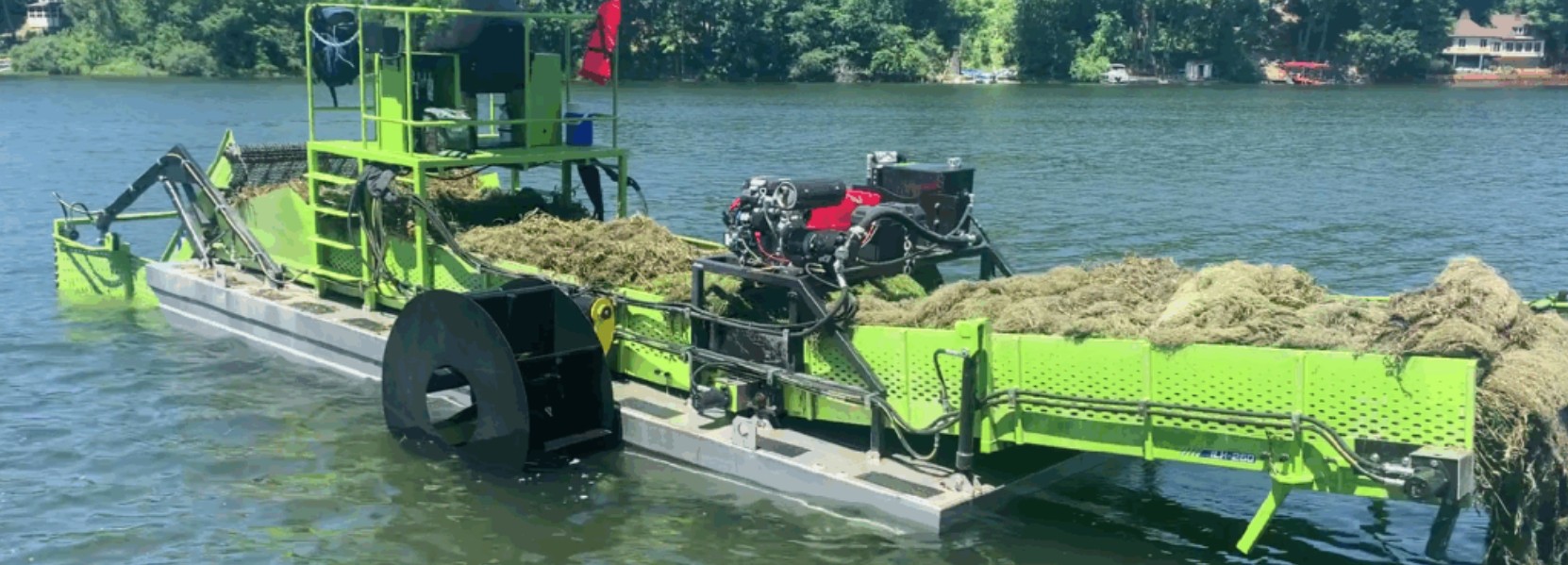
Lake Harvester Purchase – After this season’s work clearing paths through the coves, our Eco-Harvester has deteriorated beyond reliable repair. For context, we bought the current harvester “used” in 2016 which then saw minimal use and then sat idle. We brought it out of moth balls and in 2025 did some limited use. Unfortunately the extent of its design limitations and mechanical problems were not uncovered until this year’s work pushed it hard.
Given its limitations and after consulting manufacturers, the Association ordered a new harvester from Inland Harvester in Wisconsin. The ILH7-250 with tandem trailer will be delivered late next summer at a cost of $132,400. This harvester is better suited to our needs reaching depths of up to 6 feet with an actual cutter bar. It has larger onboard capacity and will unload more efficiently even into a barge to reduce travel, which will improve productivity. We will repair the current harvester as much as practical and use it to support the dredge until it no longer operates.
Aquatic Vegetation Management plan – please read the one page plan included in the Budget Ballot Package mailing in addition to reading the rest of this article. Together the information should answer the burning question everyone has on what about next year.
This year, dense, shoreline-to-shoreline Naiad Grass trapped Duckweed (Lemna minor) in shallow coves and along the shoreline, forming mats that wind could not move. With no heavy rains to flush the lake, those matts grew. Any loose Duckweed you may have seen was pushed around the lake by the wind. The question is: how do we manage aquatic vegetation going forward?
First, for grasses, mechanical removal through dredging combined with the new harvester are the primary big impact actions. Dredging removes the grass, nutrients and deepens the water level to reduce the potential growth areas. The harvester becomes the mechanical removal for where we are not dredging. The new harvester can clean out any dense growth areas and clean up surface areas. For 2027 depending on delivery of our new harvester, we will do our best to limp along with our current harvester and third party help like this year.
Of course getting to all areas around the lake will take time and repetition depending on the years variables. The Association will only be clearing a navigation path and as much of the coves main body of water as possible. Between docks will be the individual owner’s responsibility. Manual removal around docks can be effective with the right tools and manpower, so plan ahead. Whether harvested by the Association or homeowner, there is one downside to manual removal of grasses. If the roots stay intact the plant grows back quickly and any broken vegetation acts as a natural propagation method. This is why there is no silver bullet solution.
Another mechanical/natural method is the stocking of triploid (sterile) Grass Carp an otherwise invasive species that eats grass, then duckweed, then other fish. The carp eat the grass and break it up leaving about half of what they try to eat to fall to the bottom. Like cutting mechanically this reduces the grass and helps future propagation. So the Grass Carp can reduce the reliance on machine and manual methods through a balanced stocking plan. Yes, in some years potentially no need to even use the harvester, but that also means we may be overstocked.
In addition to removing vegetation, continued routine dredging operations clears out nutrients and maintains deeper water where possible reducing potential growth areas. Together, these measures put us in a much better position to manage aquatic vegetation year after year, especially when conditions hit their peak.
When it comes to Duckweed mechanical removal is hit or miss and most impactful when matted. Grass Carp will eat, but not their first choice. So it mother nature doesn’t help us out with a good lake flushing rain, we may have to rely on the use of limited herbicide applications by a professional 3rd party lake-management firm. Any herbicide treatment requires that area of the lake to be closed during and after the treatment for several days. Rain events, wind and other factors play a role in determining treatments and in a lake our size can have very limited impact.
Also, the claim “lake safe” for herbicides is a bit misleading. The safe is not because the chemicals themselves are safe, rather because the application is done in a way to reduce potential harm. Spot spraying in areas with little to no current will be our area of focus if we use herbicides.
The bottom line is that we have a plan underway to improve our response in 2027. Dredging will be our primary tool for removing grass and nutrients, while the harvesters will help keep navigation routes open. Any herbicide applications will be strictly managed as a last resort for limited areas. REMINDER: Members must not apply chemicals to the lake. Anyone caught doing so will lose lake privileges for the year. Only approved aquatic herbicides may be used, and they must be applied by a certified service provider.
For this year, the Naiad and Duckweed are gradually dying as temperatures fall. Therefore this year’s efforts are done. However, the decaying material settles to the bottom and can seed next year’s growth, so the above plan is in place. Like Zebra Mussels, aquatic vegetation will be back and depending on mother nature’s input potentially a problem we all will have to work through.
Spire Project – project moves to Phase II as the crews move past W block. With the service line installed in the Phase I area, they will start to do live cutover of the new main infrastructure for that section.
Socket Fiber – We are aware of concerns about the installation contractor’s daily and end-of-week cleanup and the quality of some installations. We have communicated our expectations, and the restoration crew is making good progress. Horizontal boring requires crews to dig test holes in the road to confirm utility locations before drilling. Water and gas lines were recently struck in the R & K block area because they were inaccurately marked—an unfortunate risk when records are incomplete. We will continue to monitor the work and address issues regularly with Socket Fiber. Please remember that boring involves several steps, and final restoration cannot be completed until each phase’s connections are in place. Please wait until restoration in your area is complete before calling the office with issues.
Sincerely,
Jeff Clemow
President